 Blue Book Nights
How I work
The rules every case goes through before it becomes a film, and what you are looking at when you watch one.
The papers come first
A case gets picked only if it left a trail I can read: police and sheriff’s reports, newspapers of that week, Project Blue Book files, letters, lab sheets, the witness’s own drawings.
Before a script exists, every claim goes into a fact sheet with its source next to it. Every date, name and number in the narration comes from that sheet. If two records disagree, the film says so out loud instead of picking the better story.
When I could not find an original and had to rely on a later printing of it, the case page says that too.
One case, told in order
Each film stays with one case: the place, the hour, the people, then what was written down and by whom. I tell it in the order it happened.
Every film gives the best ordinary explanation I could find, and then the part of the record it does not cover. There is no verdict at the end. You get the open question and you can make up your own mind.
What is real on screen
Nobody photographed these nights, so the scenes are paintings made for each video, in the gouache style of 1950s illustration. They are meant to look painted. I do not make images that could pass for photographs of a real event.
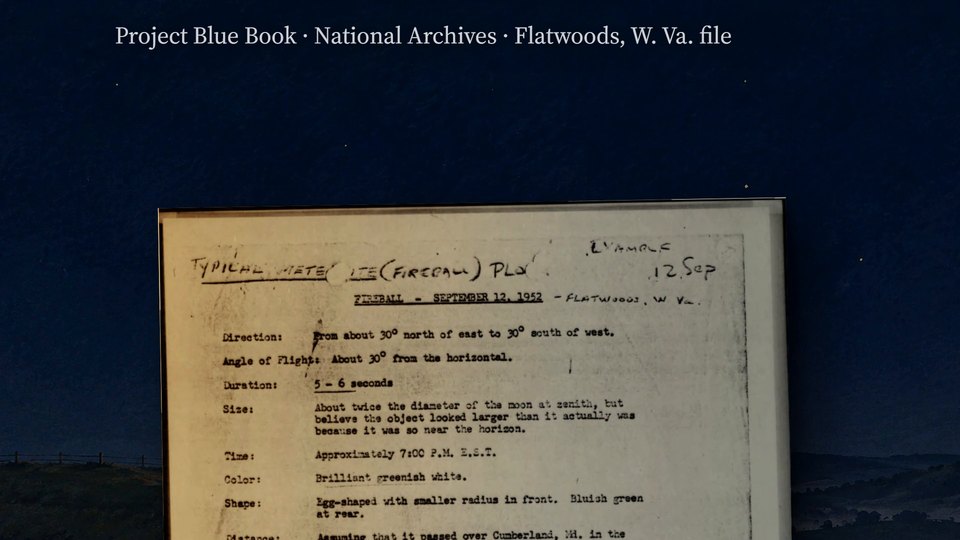
Where a real photograph, document page, witness sketch or map exists and the rights allow it, the film shows the real thing, and the case page lists it with its holder and licence.
Some papers on screen are re-set in type for the film from the wording of the source, when no scan was available or the scan could not be used. The case page says which. Maps are drawn for each film from public domain map data.
Children are never shown, in paintings or in photographs.
What you hear
The narration is a synthetic voice. That is stated on every case page here and in the film descriptions from Case 04 on.
The script is written for each case from its fact sheet. When the narration says “I checked”, the check was really made, and the case page shows what it was made against.
The people in the stories
These were real people, and most of them were ordinary: a farmer, a patrolman, a plumber. The films take their accounts seriously and quote them from the record. I do not put words in their mouths, and I do not mock them.
Corrections
If you think a film has a fact wrong, leave a comment under the video with your source. I read every comment.
When I was wrong, the correction goes into the video description and into the log below, with the date.
Who makes this
Blue Book Nights is an independent channel run by one person. I stay off screen on purpose: the witnesses and the papers are the story.
The channel is not connected with the United States Air Force or with any UFO organization. The name comes from Project Blue Book, the Air Force study of UFO reports that closed in 1969.